
Finding Brownsville Residents by Record
Brownsville does not have one official roll that names every person at every address. The useful Brownsville residents directory trail depends on the question. Cameron County Appraisal District, known as CAD, is the starting point for a current owner or parcel connection. The Texas registration tool can confirm a searched voter through its own identity modes. The County Clerk’s deed indexes show parties to recorded instruments, not a live roster. For earlier households, library, newspaper, archive, and microfilm routes can place a name at a date and address.
Keep a note of the spelling, date, and source for each match. Brownsville names often appear with accents, compound surnames, initials, former surnames, or English and Spanish forms. A match becomes stronger when a second official source independently connects the same person, date, and place. A property owner, for example, need not be the current occupant. A directory entry can document a past household, but it does not show a later move.
- Search CAD by owner name or property address and save the PID, GEO ID, situs address, and legal description shown.
- Use the official Texas registration lookup only for a registration question, then record the result’s jurisdiction rather than inferring more.
- Search the County Clerk’s current or historic index for a deed, lien, release, or other recorded connection.
- Match an older name or address through Brownsville directory holdings, newspaper search, cemetery material, or Texas State Library microfilm.
- Ask the specific custodian for a public record that is not online, using a focused request with dates and identifiers.
Brownsville Resident Record Custodians
Brownsville resident records are divided among city, county, and state offices. The Cameron County Clerk records instruments and maintains the official-records and historic-index routes. CAD maintains property appraisal records separately from the county tax office. Cameron County Elections handles local registration administration, while the statewide tool handles voter lookup. City Secretary records, municipal dockets, and Texas DSHS vital records each have their own access path. Starting with the right custodian avoids a search that cannot answer the question.
Cameron County Clerk
Official records, historic index books, vital services, and assumed-name routes.
956-544-0815
Cameron CAD
Current parcel ownership, situs and mailing fields, exemptions, taxing units, and estimated tax data.
Cameron County Elections
County registrar services and the official state registration lookup route.
Brownsville CAD Search Keys
CAD documents four ways to begin a Brownsville property search: PID number, GEO ID number, address, and owner name. A returned account can show the property description, ownership, applicable mailing information, situs address, exemptions or special valuations, taxing units, and an estimated tax-year amount. CAD does not issue physical addresses, deeds, or subdivision plats, so those questions move to the city or County Clerk. Its public interface was JavaScript-dependent during research, which means unobserved filters, sorting, exports, and result limits should not be assumed.
| CAD search key | Format | What is confirmed |
|---|---|---|
| PID | Property identifier | CAD account route |
| GEO ID | Geographic identifier | CAD geographic account route |
| Address | Situs/property address | Property connection |
| Owner name | Name search | Assessed ownership lead |
Note: CAD distinguishes a parcel’s situs from any mailing address, so save both labels before treating either field as a current Brownsville residence claim.
Brownsville Voter Lookup Modes
The official Texas voter lookup offers three verified starting modes: VUID, Texas driver-license or identification number, and first-and-last name. Use the most specific lawful mode available. The result can help confirm a registration match and jurisdiction, but it is not a general Brownsville household directory. Ballot choices are not public. Full voter-list access follows a separate request, affidavit, fee, and use-restriction process under the Election Code, and protected fields stay withheld.
Cameron County Elections is the local registrar route for county questions, ballot materials, results, and voter-file procedures. The screenshot below shows that office’s public entry point, not a list of people or addresses.
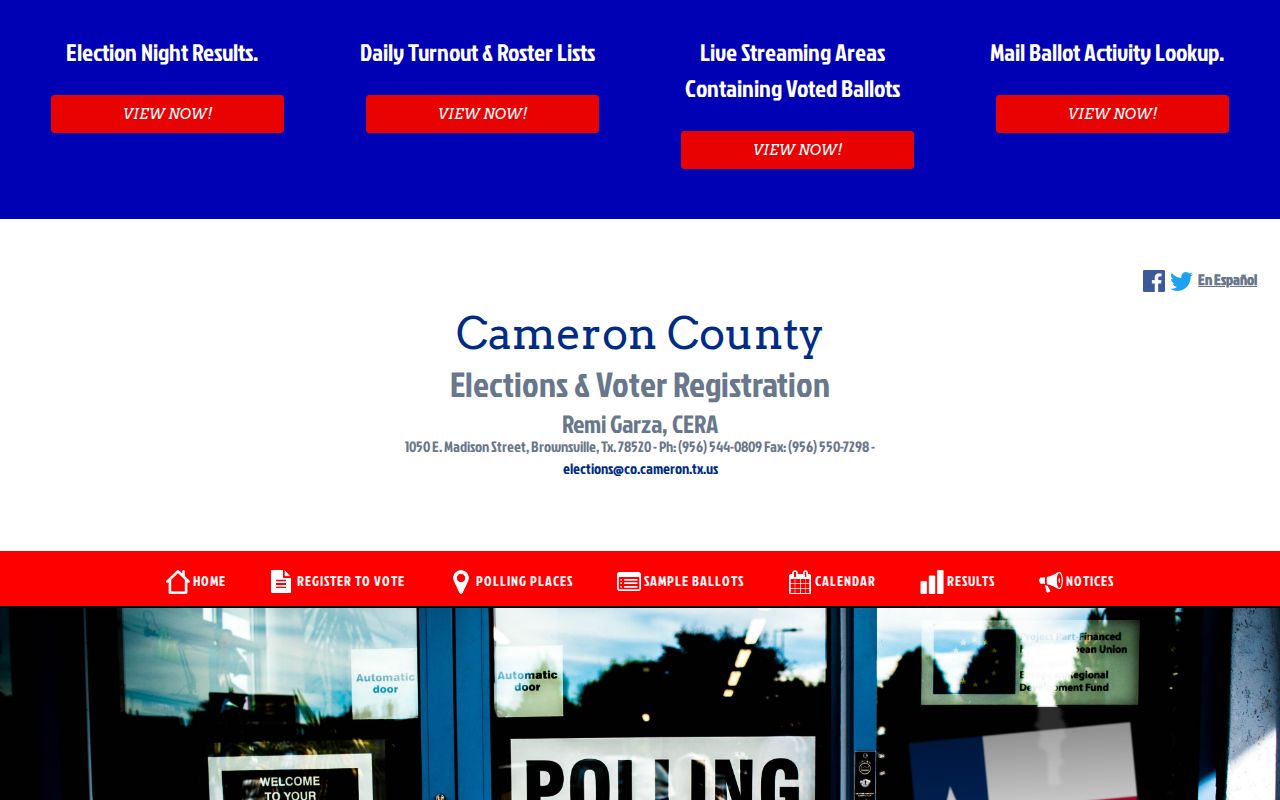
Use the county office when a search needs the local registrar or the documented voter-file request process.
Brownsville Deed Index Trails
The County Clerk keeps two different Brownsville deed-index routes. The current Official Public Records search has a search-term field for grantor, grantee, subdivision, document type, or document number, a date pair, quick date ranges, and index-only or index-and-OCR controls. The historic Kofile index uses type, year, parties, last name, first name, and book, volume, or page controls. Historic books reach 1830 through 1968, with linked books or documents identified for 1830 through 1957.
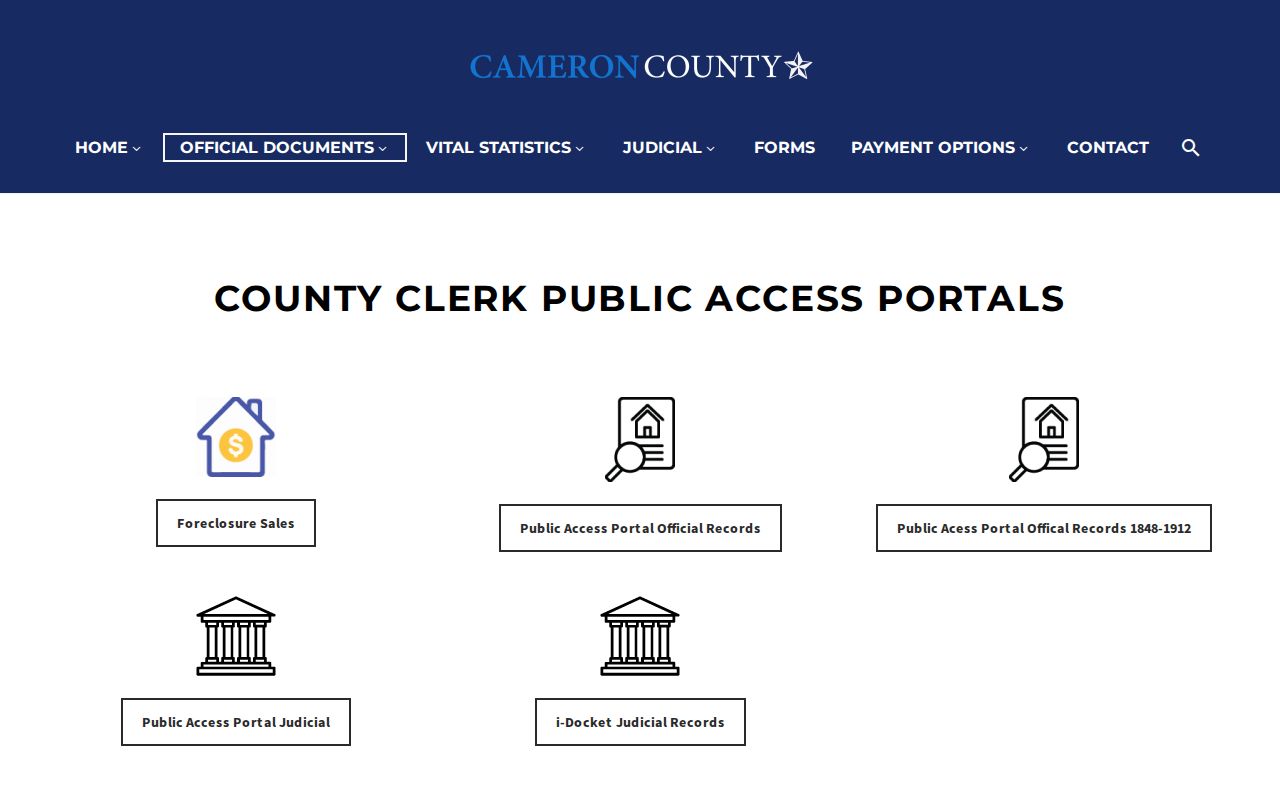
A deed index is a party trail. It can locate an instrument, recording date, document type, and book or document number, but an index name alone does not prove current residency. The County Clerk portal list shows the separation between current and historic systems.
The Clerk’s public-access portal page places those choices in one official gateway.
A street-by-street chain needs the parcel and deed mechanics described in the Brownsville street directory.
Brownsville Resident Directory Sources Today
Today’s Brownsville resident directories are purpose-built records rather than a single published book. Each source has a narrow use. CAD helps with assessed ownership. The voter system handles registration. Clerk indexes identify recorded parties. Courts, licenses, business filings, and city boards can add carefully limited context. None should be stretched into a complete roster of residents, and a no-result often means the person or question belongs with a different custodian.
| Brownsville source | Connection it can show | Custodian | Access route |
|---|---|---|---|
| CAD property roll | Assessed owner, parcel, situs | Cameron CAD | Public search and records request |
| Registration lookup | Registration match and jurisdiction | Texas and Cameron Elections | Official lookup modes |
| Deed index | Recorded instrument parties | Cameron County Clerk | Current and historic portals |
| Court docket | Party role, case, date, status | District Clerk or court | Portal, counter, mail, or email |
| Historical collections | Past household or community context | Library, TSL, BHA | Catalog, microfilm, archive request |
The status and scope of every row matter. A record may establish ownership, a court role, a registration match, or a historical address without establishing all of those things at once.
Brownsville Court Search Context
Cameron County District Clerk files are the local route for district civil and criminal records, with county court and probate routing varying by case type. The clerk accepts copy requests in person, by mail, or by email. If a case number is unknown, it may search by names, case type, filing dates, and date of birth for a $5 search. Same-day service is usual unless a file is in storage, when the office says 24 hours may be needed. The statewide court search refreshes nightly rather than in real time, and the clerk controls the original file.
District Clerk guidance provides the local request route and records contact.
Sealed, juvenile, expunged, adoption-related, protected-family, and victim-protected material remains outside ordinary public access.
Brownsville Vital Record Gates
Texas keeps public index access and certified vital-record access separate. Under Texas Government Code §552.115, birth records become public after 75 years and death records after 25 years. Current certificates remain eligibility-limited. Texas DSHS offers online, mail, and in-person ordering, while local routes include the Brownsville registrar and Cameron County Clerk. DSHS says most online orders take 20 to 25 business days and are nonrefundable. A verification letter contains less than a certificate, generally confirming name, date, and county or location.
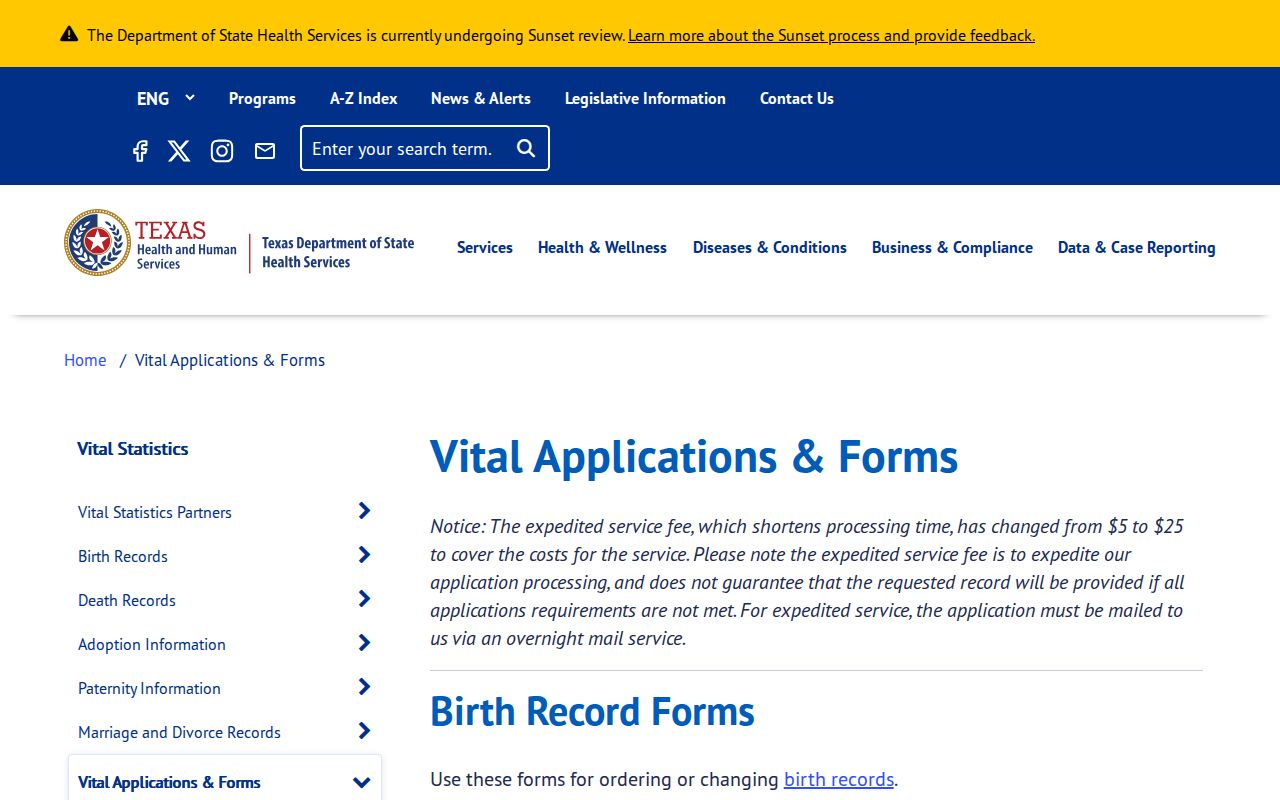
Texas DSHS vital application forms identify the official forms instead of treating an index result as a certified record.
For a historical household, an eligible certificate or public index should be checked against the date, cemetery, obituary, directory, or probate trail.
Brownsville Historical Resident Directories
Older Brownsville resident directories are distributed across institutions. The Texas State Library lists Brownsville volumes for 1966, 1968, 1970, 1971, 1973, 1978, a 1978 residential directory, and 1982. A Texas Historical Commission survey also cites a 1913 to 1914 Brownsville City Directory. Brownsville Public Library provides in-library Ancestry Library Edition and a catalog route, while the Brownsville Herald archive offers full-text, date, and place searching. Ask library staff about unlisted microfilm, yearbooks, and local-reference material.
Texas State Library microfilm adds Brownsville city birth transcriptions for 1914 through 1939, city death records for 1910 through 1977, burial permits, cemetery records, court minutes, and deed-of-trust indexes. The dedicated Brownsville city directory page explains how to read these historical directory collections without treating them as current records.
Brownsville Record Access Compared
Official sources and commercial people-finder products work differently. An official record names its custodian and has a defined scope, while a commercial product may combine old public indexes, marketing data, and other inputs with uneven update timing. A commercial display can merge people with the same name or retain a stale address. The better Brownsville practice is to use an index as a lead, then verify the stated fact with the office, court, archive, or library that holds it.
| Official custodian | Commercial people-finder category |
|---|---|
| States what its record contains and how to request it. | May combine sources with different dates and unknown matching rules. |
| Can explain a copy, correction, or restricted-access process. | Cannot correct the original county or state record. |
| Supports reproducible citations such as file, book, date, or case number. | Requires independent confirmation before reliance. |
Brownsville Privacy Boundaries
Public availability has limits. Texas voter law protects Social Security, Texas driver-license, and DPS identification numbers along with protected residence information. The federal Driver’s Privacy Protection Act limits motor-vehicle personal information. Court files can be restricted, and a public deed or CAD record may still call for a custodian’s redaction process. Texas’s Address Confidentiality Program provides a substitute address and mail forwarding for qualifying survivors. It is not appropriate to use related records to work backward toward a protected residence.
Texas also permits a specific public-record request under the Texas Public Information Act, Government Code Chapter 552. Name the record, office, date range, and preferred delivery method. If a record is not online, the Clerk counter, library, archive, city custodian, or written request may be the only documented route.
Brownsville Cemetery Mapping
Brownsville’s Old City Cemetery was established in 1850 and gives historical research a local anchor. Its city map labels blocks, plots, burial names, trees, and water outlets, while excluding the Hebrew or Jewish cemetery. In February 2026, the city announced phased GIS work to map individual graves and planned public digital burial records. Until that layer is available, use the facility page and map, City Secretary cemetery records, Brownsville Historical Association material, and Texas State Library microfilm as a combined access chain.
The timing matters because an online map can be a useful locator without being a complete burial index. Preserve the cemetery block, marker spelling, map source, and date with any research note.
Brownsville Offline Records Trail
Brownsville’s strongest research fact is that a record can survive without being searchable online. Historic Kofile books, TSL microfilm, Brownsville Historical Association collections, library holdings, clerk counters, and court copy requests fill different gaps. The historical association accepts targeted requests for a person, address, organization, property, or photograph; its preliminary search is $25, with a stated response time of up to six weeks and further research billed separately. Its collections include land grants, photographs, manuscripts, newspapers, drawings, and archives.
Use the source’s own reference number whenever possible. A book and page, reel, date, PID, GEO ID, cause number, or catalog identifier makes the next check repeatable and helps separate a real Brownsville record gap from a simple search mismatch.
The Brownsville City Secretary is the municipal records custodian for legislative material, municipal records management, vital-statistics functions, and cemetery records. Its records-management work includes retention schedules, storage, preservation, destruction, historical and permanent records, and digitization. A city ordinance, resolution, minutes set, board item, cemetery record, or election-coordination record that is not found through a public portal should be described in a written request to that custodian. Research did not locate a complete city request form or fee table, so confirm the current procedure with the office.
CAD also documents a written open-records fallback by mail, fax, email, or in person. A request can identify an owner, physical address, legal description, or map. When research cannot be completed within 10 working days, CAD says it will provide a completion date and time. An estimate is required before production when charges exceed $40. That access channel is useful when a public portal does not show the needed appraisal-card or map material, but it does not turn an unverified portal field into a promised result.
County and city material has to be requested from the office that owns it. The Texas Public Information Act does not require a requester to explain a reason, and the Comptroller says governmental bodies must treat requesters equally. A precise description, date range, record type, relevant name or address, and preferred delivery method give a custodian the practical information needed to locate a Brownsville record. Keep any estimate, response date, and request reference with the rest of the research trail.
For records older than a live portal, the fallback sequence is often a clerk book, a microfilm reel, a local library reference desk, or an archive request. That is especially true in Brownsville, where current and historic deed systems are separate and the Texas State Library finding aid lists record runs that cannot be assumed to appear in a modern name search. A careful no-result note records what was searched, which years were covered, and which remaining custodian or collection can still be checked.