
Brownsville City Directory Collections
The confirmed Brownsville directory shelf is small but useful. The Texas State Library and Archives Commission holdings list names volumes for 1966, 1968, 1970, 1971, 1973, 1978, a separate 1978 Residential directory, and 1982. A Texas Historical Commission survey also cites a Brownsville historical directory for 1913-1914. Brownsville researchers should preserve the state-library citation beside each copied entry. The visible holdings list does not identify publishers, so a title page or catalog record is needed before attaching a publisher name to any volume. The 1978 Residential item deserves separate treatment because it is described as residential and address oriented.
| Collection | Years | Where Held | Access |
|---|---|---|---|
| Brownsville historical directory reference | 1913-1914 | Texas Historical Commission survey citation | Holding location needs confirmation |
| Brownsville historical volumes | 1966, 1968, 1970, 1971, 1973, 1978, 1982 | Texas State Library and Archives Commission | Ask TSL for the call number and reproduction options |
| Brownsville Residential directory | 1978 | Texas State Library and Archives Commission | Separate residential, address-oriented holding |
| Brownsville reverse or criss-cross run | Not confirmed | Start with BPL, TSL, the Library of Congress guide, and BHA | Brownsville staff confirmation required |
Gaps matter. A volume that is not on the official shelf list should be logged as unconfirmed, not treated as a missing Brownsville household. The TSL city-directory guide points researchers toward local libraries, the Portal to Texas History, TexShare HeritageQuest, and other repositories when a listed year is not immediately available.
Brownsville Directory Years at TSL
The Brownsville state-library run creates several fixed points after the mid-1960s. Use the general volumes to compare a surname, address, or printed business notation across the listed years. Treat the 1978 Residential volume as an additional address-focused check, not a replacement for the standard directory. Brownsville Public Library can also be a practical local stop: its catalog identifies Central Library and in-library Ancestry Library Edition access, though the catalog did not expose a complete directory, yearbook, obituary-index, or reverse-directory inventory.
The Texas State Library city-directory research guide describes routes through libraries and digitized repositories. Its guidance is useful when a Brownsville title is not online, but it does not prove that every Brownsville volume is digitized. Ask a librarian to check unlisted microfilm, local-reference binders, telephone books, yearbooks, and institutional databases before concluding a volume is unavailable.
The Texas State Library directory guide shows the research routes behind the Brownsville shelf search.
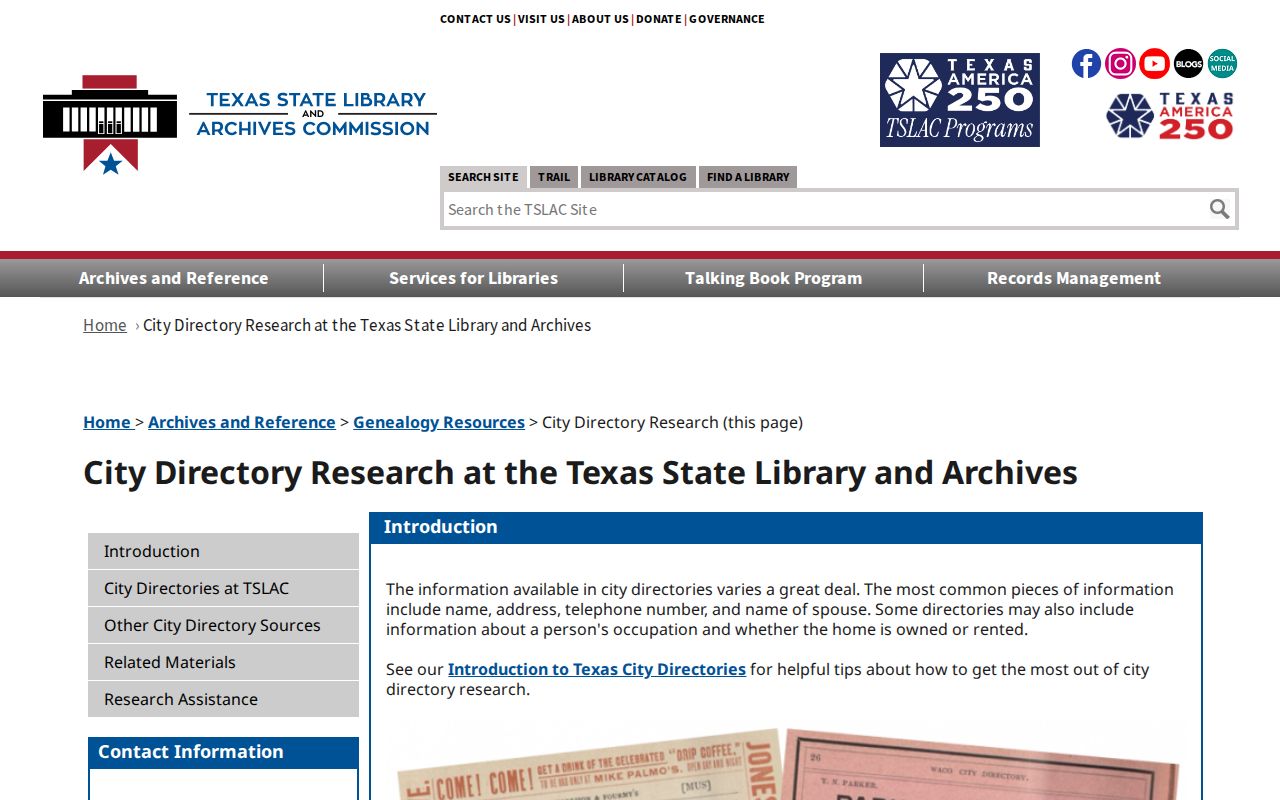
The guide supports a repository-first search when an exact Brownsville directory year is not visible in a public catalog.
Note: Preserve the printed title, year, repository, and page number so another researcher can return to the same Brownsville volume.
Brownsville Directory Archive Routes
The Brownsville Historical Association holds approximately 18,000 objects and records, including photographs, manuscripts, land grants, architectural drawings, newspapers, rare books, and the Hunter Room Collection. Its South Texas photograph archive is organized by location or address, people, objects, and events. That makes it a good Brownsville companion for an address appearing in a printed volume, especially when a building, family name, or local organization needs historical context.
BHA research requires advance arrangements. A targeted request may cover a person, address, organization, property, or photograph. The published route is a nonrefundable $25 preliminary search with a stated response time of six weeks, followed by a summary and quote when material is found. A Brownsville request should use only the exact name variants, address forms, and date range already documented in the directory notes.
For request instructions, consult the Brownsville Historical Association collections research page.
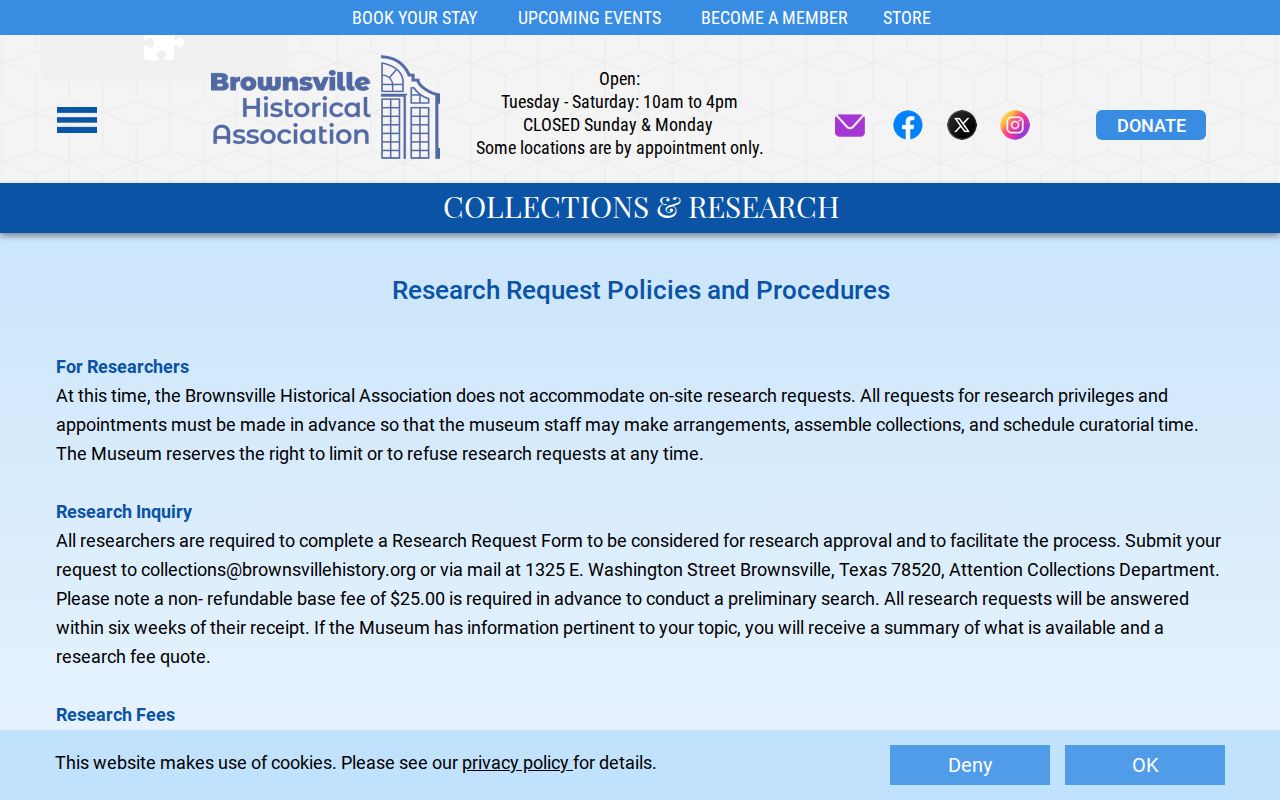
The request screen is a useful reminder that the association is an arranged-research route, not a walk-in historical shelf.
Reading Brownsville Directory Entries
A directory entry must be read as a dated, compiled listing. The 1913-1914 Brownsville reference gives a specific warning: the Texas Historical Commission survey records different addresses for José Fernández in the alphabetical and street sections. Search both Brownsville sections, retain accents and original spelling, and cite each version. The static survey excerpt did not reproduce the full line, so unshown details such as spouse notation, telephone number, dwelling marks, and abbreviation meanings should never be assumed for that volume.
| Name | Copy surname, given name, initials, accents, and any printed variant exactly. |
|---|---|
| Address | Record the house number, street form, and whether it came from the alphabetical or street section. |
| Printed role | Note an occupation, company, or civic notation only if it appears in the actual entry. |
| Family notation | Capture a spouse, widow or widower notation only when printed. |
| Abbreviations | Photograph or transcribe the volume's own key before expanding a shortened word. |
- Criss-cross directory
- An address-ordered directory that can connect a street number to a listed occupant. A complete Brownsville run has not been confirmed.
- Householder index
- A listing arranged around a named household or address, rather than a complete count of everyone at the location.
- Abbreviation key
- The printed explanation for shortened labels and marks. Its meaning belongs to that edition, not to a generic directory rule.
Brownsville Directory Name Forms
Brownsville records often cross Spanish and English indexing habits. A person may appear with a Spanish given name, an English rendering, compound surname, maiden name, initials, or an accent omitted by a database. Search variants, but preserve the form shown in the source. The same care applies to a street label, because the local research has not located an official street-renumbering schedule or a verified reverse-directory run.
When a Brownsville result seems to vanish, test the prior and later directory years, nearby odd or even house numbers, street intersections, lot or block language, and the historical city or county boundary. A mismatch is a question for the record trail, not proof that the person moved at a particular time.
For current address-keyed records after an old listing has been identified, the Brownsville street directory explains the modern GIS, parcel, and deed path.
Tracing Brownsville Directory Households
Use a Brownsville printed volume as one date-stamped household snapshot, then test it against another record type. Federal census images and indexes through 1950 are public under the 72-year release rule. A census provides household composition and birthplace context; a directory can provide a closer-in-time address; a deed supplies legal ownership; a newspaper notice can add a relationship or event date. None should be stretched to answer every question.
- Find the earliest confirmed Brownsville directory entry and copy its spelling, section, and address exactly.
- Check the next available directory year and record the address change, spelling change, or absence without guessing why.
- Compare the alphabetical and street sections when both exist, then note any conflict such as the documented José Fernández example.
- Pair 1913-1914 evidence with the 1910 and 1920 census, and pair later directory years with the 1940 or 1950 census when timing permits.
- Use the Brownsville Herald, cemetery records, probate material, or a vital index to test a move, death, or family connection.
The Brownsville Herald advanced search offers terms, AND/OR controls, place, title, and date fields. It can supply Brownsville leads from announcements, obituaries, civic notices, and addresses, but those leads need a directory, deed, court, or vital record check before they are treated as settled facts.
Brownsville Directory Timeline and Gaps
Brownsville's record trail is distributed among county books, city offices, state repositories, microfilm, newspapers, and historical collections. The county became organized in 1848 and Brownsville was chosen as the seat that December. Surviving material is therefore not one online catalog. The important distinction is custody versus digitization: a record can survive in a library, archive, clerk book, or microfilm reel without being searchable by name on the web.
- 1913-1914: A Brownsville historical directory is cited by the Texas Historical Commission survey, including the documented alphabetical and street-section address conflict.
- 1966-1982: TSL lists Brownsville volumes for 1966, 1968, 1970, 1971, 1973, 1978, 1978 Residential, and 1982.
- 1830-1968: Cameron's historic index books provide a separate, older deed-index route that may help place a property record beside a directory finding.
- 2026: The city announced phased GIS work toward public digital burial records at Old City Cemetery.
No verified courthouse fire, flood, or total records-loss event was found in the reviewed material. Known gaps include material remaining on microfilm, a burial-permit gap from June 1938 through 1939, unconfirmed publishers, and no verified local reverse-directory shelf. Record a negative search with its custodian and coverage limit.
Brownsville Directory Map Context
Sanborn fire-insurance maps can place an old Brownsville address in its physical setting. Authoritative references identify local editions from 1877, 1914, 1919, 1926, 1930, and 1949; the Library of Congress 1926 Brownsville map is a digitized 15-sheet edition. A map can show a building footprint, lot context, street geometry, and historic use. It is not an occupant list.
When a Brownsville directory street form is uncertain, compare the map sheet with the printed address, a nearby intersection, and the city GIS address and parcel layers. The city map warns that parcel boundaries are approximate and not a survey, so confirm any ownership question through Cameron CAD and the County Clerk rather than a map polygon alone.
Note: A map can explain a changed streetscape, but it cannot establish that a named person lived at a Brownsville address.
Brownsville Directory Record Trail
For a family-history trail, keep a small source log with the exact printed edition, page, section, original name form, address, and repository. Then add the census year, map sheet, newspaper issue, or deed index reference that tests the entry. This method is especially useful when the alphabetical and street sections differ or when a surname has more than one spelling.
Old City Cemetery is another Brownsville historical context source. Established in 1850, its city map labels blocks and plot or burial names but does not include the Hebrew or Jewish cemetery. The city's phased grave-mapping initiative may produce public digital burial records later. Until then, use the city facility record, map, City Secretary material, and BHA as separate access channels.